 josh white
How to Budget a 90-Day DTC Test Without Burning Cash
A 90-day DTC test has one job. It tells you whether you can buy new customers at a cost your margin and your cash can carry. That's it. Not revenue, not ROAS, not followers. The question is nCAC, and whether it gets efficient enough, fast enough, to be worth scaling.
I get asked to put a budget around this a lot. Sometimes it's a founder launching a brand that hasn't sold a unit yet. Sometimes it's a retail brand adding DTC, or a CEO or board member deciding whether to fund the test at all. The mistake is the same in every version: a number gets picked ("let's put $50K into Meta and see what happens"), the money goes out evenly, and at day 90 nobody can say whether it worked because nobody decided up front what "worked" means.
Here's how I'd set it up so you learn the answer without spending the whole budget to get it.
the goal is nCAC efficiency
nCAC is what you pay to get one new customer. Not one purchase, one new customer. The test is trying to prove two things about it:
- nCAC comes down to a number you can live with. Your margin sets that number, not a benchmark.
- It stays there as you spend more. A good nCAC at $1,000 a week doesn't mean much until you've seen what happens at $4,000.
Before any money goes out, write down your nCAC ceiling. The simplest version is first-order contribution margin: what a new customer's first order leaves you after COGS, shipping, fulfillment, payment fees and the discount you gave them. If you have repeat data you trust, you can stretch the ceiling to what a customer leaves you inside a payback window you can actually fund. If you don't (most pre-revenue and early brands don't), use the first order. That's the conservative number and it's the one I'd plan cash around.
how to measure nCAC
Most tests go sideways here, because "CAC" ends up meaning whatever the dashboard shows that week. Lock the definition before day one and don't touch it for 90 days.
The formula. nCAC = total acquisition spend / new customers. New customers means first-time buyers only. Returning customers don't count, even if an ad brought them back.
What goes on top. Every dollar you spent to get new people in the door that week:
- Media on every paid channel (Meta, Google, TikTok, whatever you're running)
- Creator and affiliate payouts, plus the product you seeded to them
- Creative made for the test, spread across the weeks it runs
- Agency or freelancer fees if they're running acquisition
Leave out email and SMS to people who already bought, and anything that's really retention. If it's fuzzy, put it in. An nCAC that's a little too high is a lot safer than one that's flattering.
What goes on the bottom. New customers from your store, not the ad platform. In Shopify that's customers whose first order landed that week. Take out wholesale orders, replacements, $0 orders and friends and family. If you're pre-revenue, tag those launch-week orders from your network now, because they'll make week one look a lot better than it was.
Blended vs. platform. Run both, and use them for different jobs. Blended nCAC (all spend over all new customers from your store) is the number you make budget decisions on. Platform CPA is for deciding which ads and audiences get more money inside a channel. Platforms count returning customers and give themselves credit for people who would have bought anyway, so platform CPA almost always looks better than blended. If the two start moving in opposite directions, trust blended and go figure out why.
Attribution window. Pick one per platform (7-day click, 1-day view on Meta is a fine default) and keep it for the whole test. Changing windows mid-test is how a bad week turns into a good one on paper. I'd also add a "how did you hear about us" question after checkout. It isn't perfect, but it's a cheap check on what the platforms are claiming.
Cadence. Weekly, Monday to Sunday, reviewed on the same day every week. Look at the week itself and a trailing 4-week number next to it, since one week of spend can be noisy, especially early. Daily is for watching spend caps, not for making calls on nCAC.
Tools. You don't need much. Shopify for new vs. returning customers, each ad platform for spend, your books for creator and agency costs, and one sheet that puts them together every Monday. If you can get it into a live model that ties spend to your P&L and cash, even better, but don't hold the launch for that.
what to expect: high out the gate, then it should normalize
Your nCAC is going to be ugly in the first few weeks. That's normal. The platforms are still learning who buys, you haven't found your winning angles yet and most of your creative won't work. If week two scares you into killing the test, you never get to see what the number really is.
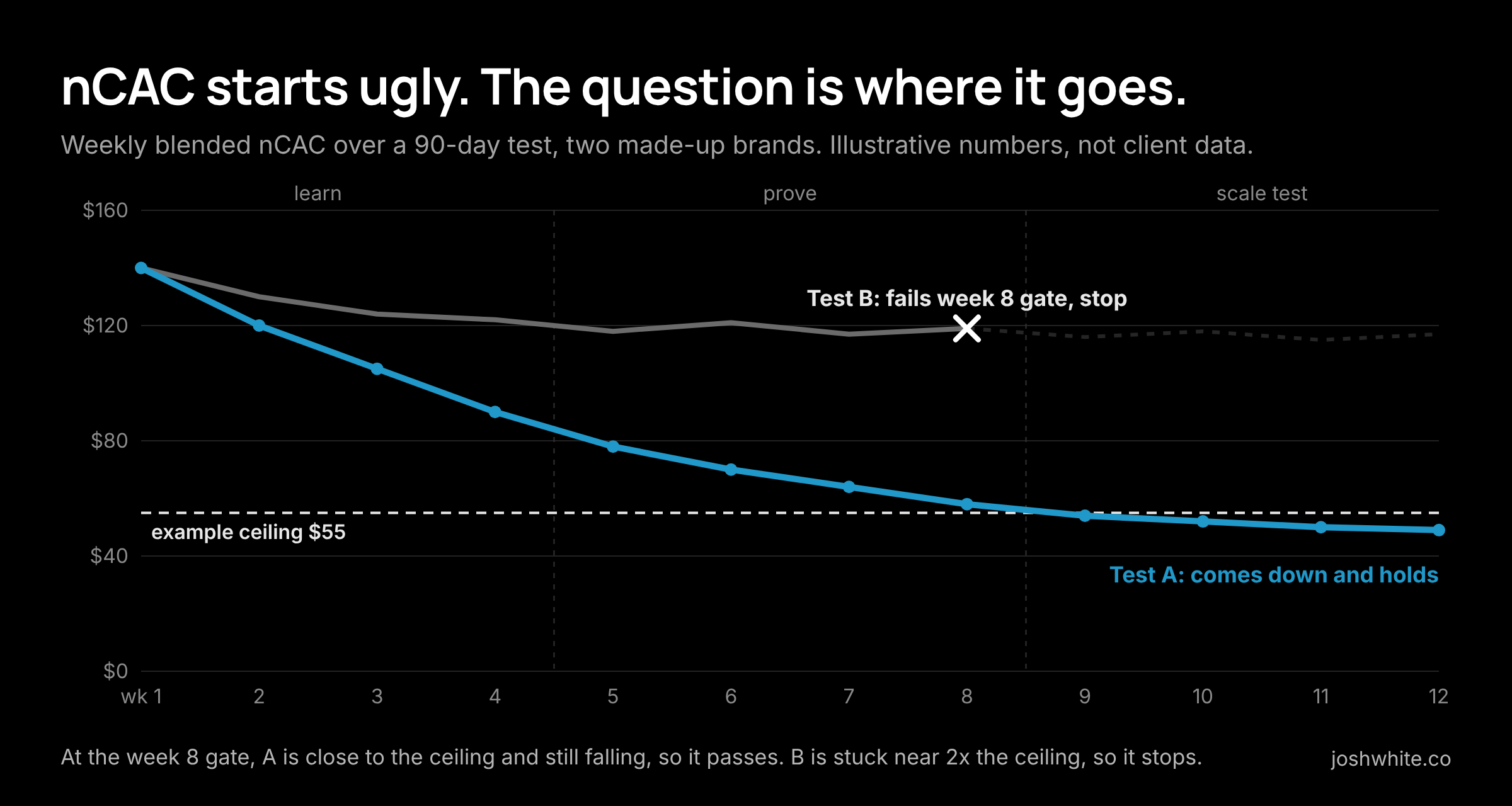
What you're looking for in the first 4 weeks isn't a good number, it's a direction. Test A in that chart looks terrible in week 2 and turns into a business by week 9. Test B never really moves, so it gets stopped at the week 8 gate instead of eating the scale budget. Those two tests can look about the same at day 14, and very different at day 45. The whole budget plan below exists so you can afford to wait long enough to tell them apart, and not a lot longer.
budget it in three phases, not one lump
I'd split the 90 days into three phases, put the least money in the first one and only release money for the next one when a gate is met.
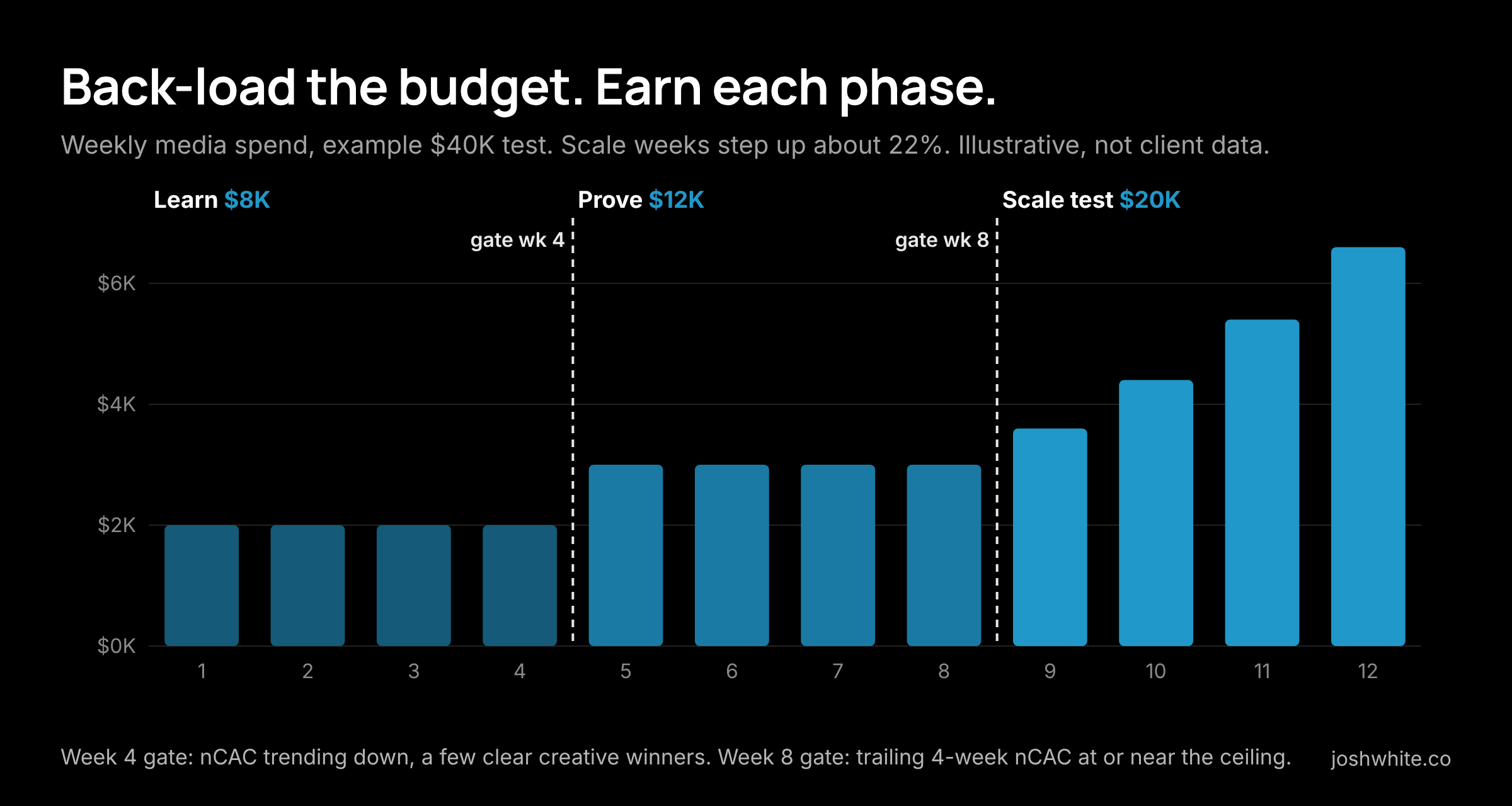
Learn (weeks 1-4). Small spend, lots of creative. The job is finding angles that work, not getting nCAC to target. I'd rather run 15 concepts at low spend than 3 concepts at high spend. Fix the page and the offer here too, because a weak product page makes every ad look bad.
Prove (weeks 5-8). Cut the losers, move money to the winners and keep feeding new creative. nCAC should be heading toward the ceiling now. Spend goes up a bit, but steady enough that you can read the number.
Scale test (weeks 9-12). This is the part people skip, and it's the part that matters most. Push spend up in steps (I like 20-30% a week) and watch whether nCAC holds. Holding at higher spend is what tells you there's a business here.
Two gates do most of the work:
- Week 4: blended nCAC is trending down week over week, at least a couple of creatives are clearly beating the rest, and the site converts well enough that you can see the path to the ceiling. If nCAC is flat at 2x the ceiling or worse, stop spending and fix the offer, page or product before you put in another dollar.
- Week 8: trailing 4-week nCAC is at or close to the ceiling. If it's still well above it and not moving, the honest call is that the test answered the question, and the answer was no for now.
cash guardrails
The test should never be what puts the business at risk. A few rules I'd hold to:
- Treat the media budget as money you can lose. If losing all of it would put payroll or your next PO at risk, the budget is too big. Make it smaller and run it longer.
- Cap it weekly, not just in total. Set a weekly spend cap per channel and check it daily. A runaway campaign can eat a phase in a few days.
- Keep fixed costs separate. Creative, tools and any agency retainer are their own line. They still go in nCAC, but they shouldn't quietly grow while media gets cut.
- Buy inventory for the test, not for the dream. Plan inventory around Test B, with a reorder ready to go if you turn out to be Test A. Ten thousand units sitting in a 3PL because you forecast the scale case is how a marketing test turns into a cash problem.
- Know when the cash actually moves. Ad platforms bill you now. Customer cash and repeat orders show up later. Put the test into a 13-week cash view so you see the gap before you're in it.
the signals that say this is scalable
At day 90 I want to be able to say yes or no, not "it's promising." These are the signals I'd want to see before putting real money behind it:
- nCAC flat or down while spend goes up. Three or more weeks in a row, through real spend increases. This is the one that matters most. A low nCAC at low spend is a hint, a steady nCAC at rising spend is proof.
- nCAC at or under first-order contribution margin. If the first order pays for the customer, everything after it is profit and you can scale with confidence. If it doesn't yet, you need repeat data to close the gap, which brings up the next one.
- Repeat is showing up. Early cohorts are coming back for a second order, and payback is getting shorter, not longer, as cohorts age. 90 days is short for repeat data, so treat this one as directional unless you sell something people reorder monthly.
- Creative hit rate is holding. New concepts keep beating your control at a steady rate, and you've got more than one winning angle. If one ad is carrying the whole account, it's fragile, because one fatigued ad takes the whole nCAC with it.
- Blended and platform agree. Not on the exact number, but on the direction. If platform CPA keeps getting better while blended nCAC gets worse, you're mostly buying returning customers or people who were coming anyway.
If you've got the first two and most of the rest, I'd scale. If you only have the first one at low spend, you haven't finished the test yet, and the right move is another 30 days in the scale phase, not a bigger budget.
before you spend the first dollar
Write down four things, one page: your nCAC ceiling, the exact nCAC formula, the gate for week 4 and week 8, and the total you're willing to lose. Get whoever's funding the test (you, your CEO, your board) to agree to that page before day one. Then the week-4 meeting is about what the data says, not about what anyone hoped it would say.
If you're about to put a number on a DTC test and want a second set of eyes on the ceiling, the phases or the cash plan, book a call and we'll go through it together.
Charts and example numbers are illustrative, made up for this article. They are not client data or industry benchmarks.

the growth engine
Want your nCAC and payback live every week?
On the Operator tier I build the Growth Engine, a live model that syncs your marketing performance daily and ties it to your P&L and cash forecast. The payback number you plan with ends up being the one in the books.
Not ready for a call? Grab the nCAC & Payback Calculator, it's free.