 josh white
How to Take a Price Increase Without Killing Velocity
If you bought Halloween candy last week you already felt this one. Groundwork Collaborative and the Century Foundation found Halloween candy favorites up 15.3% over the past year, with Mondelez gummy packs up 39% and Hershey's seasonal peanut butter cups up 23%. They point to aluminum tariffs and higher costs that are pushing up packaging.
Shoppers answered in about the way you'd expect. CNBC, citing NIQ, reported small candy packs of nine ounces or less up 24% in dollars and 14% in units, while every larger pack size is declining. People didn't stop buying candy, they bought it in a smaller bag.
It isn't just candy and it isn't just the U.S. Statistics Canada has grocery prices up 33.0% since September 2020, even with the yearly increase slowing to 1.7%. Shoppers are tired of it, and if you're a $1-10M brand with tariffs, freight and packaging all going up at once, you probably have to take a price increase anyway. Hershey and Mondelez can afford to get it a little wrong, and most small brands can't.
start with the number you actually need
Most founders I talk to start with "how much can we get away with." I'd start with how much the costs actually went up.
Take landed cost per unit by SKU (ingredients, packaging, freight in, any tariff you're paying) and compare it to what it was when you last set prices. Then figure out what price keeps your gross margin dollars whole, not just your margin percent. If a tariff added $0.40 to a unit, you need more than $0.40 at the shelf once the retailer's margin is on top of yours.
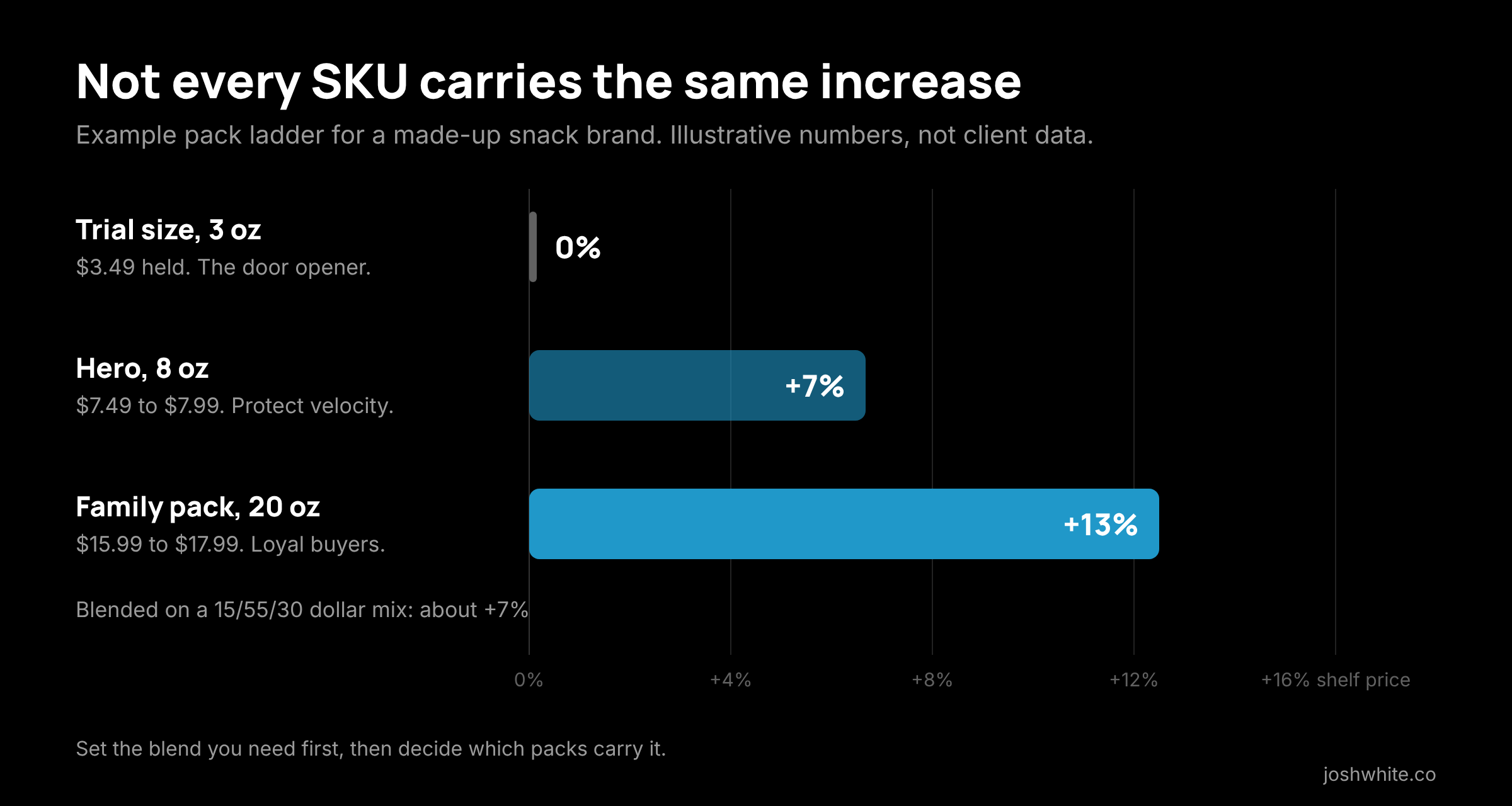
That gives you a blended increase you need across the whole line. It's a target for the mix, and it doesn't have to be the number on every single SKU.
don't put it on every SKU
This is the part I see brands skip. The easy move is 8% across the board, and I think it's usually the wrong one.
Hold the entry price
Your trial size or smallest pack is how new people find you. The candy data is the warning here: when prices go up, shoppers move to the smaller pack. If you have one at a price point that feels easy, protect it, and if you don't have one, this might be the time to build it.
Go light on the hero
Your top seller drives velocity, and velocity is what keeps you on the shelf. I'd usually give it the smallest increase you can live with, and pay attention to the price points shoppers notice, like crossing from $7.99 into the $8s.
Put more on the loyal packs
Family sizes, bundles, subscriptions and the flavors your repeat buyers love are usually where people are least price-sensitive, because they already know they like the product. That's where I'd put more of the increase.
Look at pack size, not just price
Changing the size is a real tool too, as long as you're honest about it. A new smaller pack at a new price is fine. Quietly shrinking the bag and hoping nobody notices tends to cost you trust, and trust is about all a small brand has over the big guys.
model the elasticity before you move
The math I want before any increase goes live is how much volume you can lose before the increase costs you gross profit. The formula is price increase divided by (gross margin plus price increase). At a 40% gross margin, a 10% increase can lose up to 20% of units before you're worse off than today.
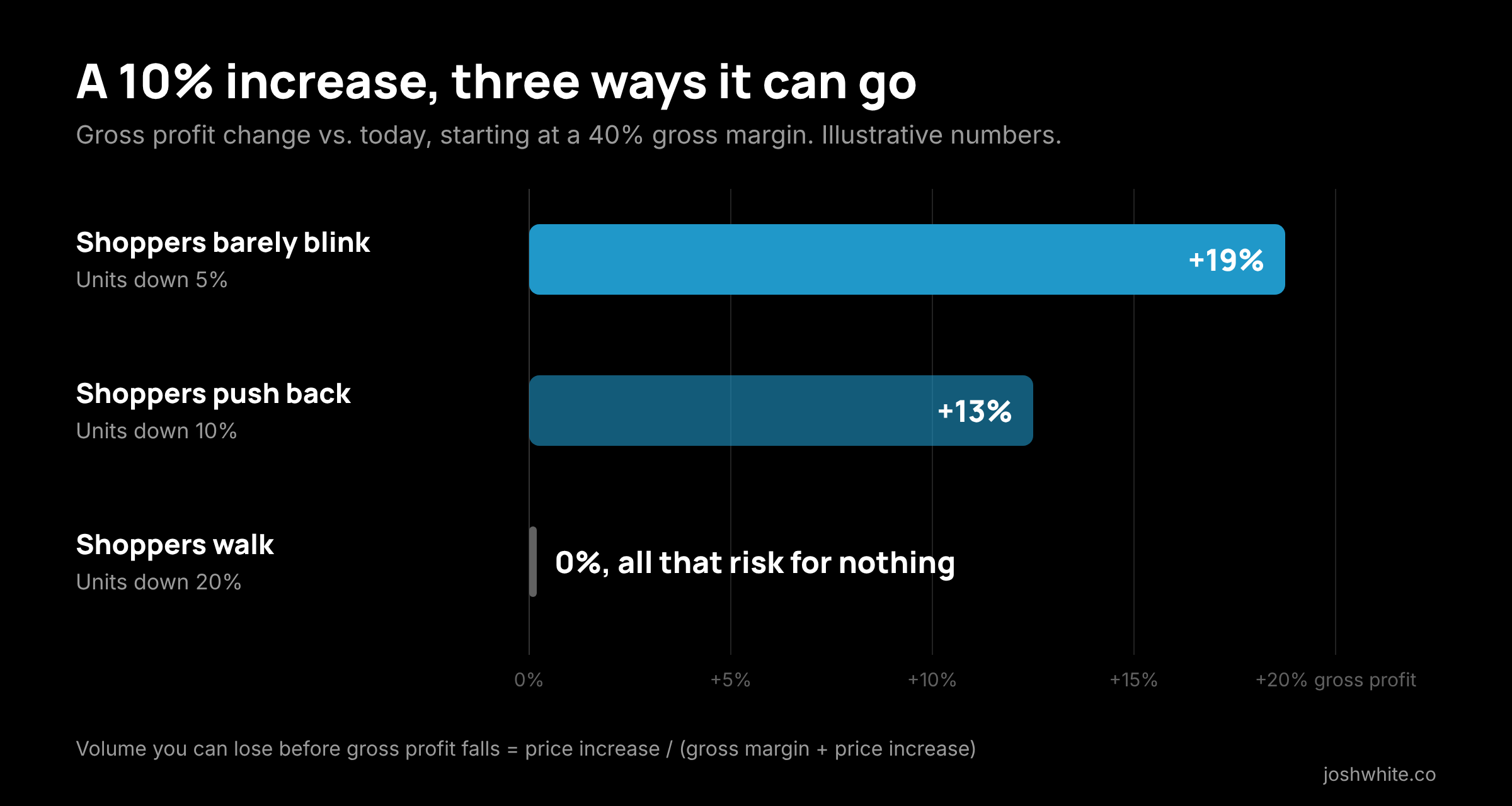
That's a made-up example, but most of the brands I see don't know which of those three bars they're on. You can get a decent read before you move:
- Look at what happened the last time you raised a price or ran a promo. A promo tells you something about how shoppers react to price, even if it isn't perfect.
- Test it on DTC first. Your own site is the cheapest place to see how a new price converts before you lock it in with a retailer for a year.
- Run it SKU by SKU. Elasticity on your hero and your family pack are usually not the same, which is the whole reason not to price them the same.
Then decide what you'll watch after it goes live. I'd look at units per store per week on the hero, repeat rate on DTC and conversion rate on the product page every week for the first couple of months, with a number written down ahead of time that tells you to change course.
the buyer conversation
Retailers are getting a lot of these requests right now, and they're pushing back. Loblaw said in October that it has pushed back on hundreds of millions in proposed supplier cost increases so far this year. You should assume your buyer is going to ask hard questions, and a small brand with a vague letter is easy to say no to.
What I'd bring:
- Cost by line. Show what went up (tariff, packaging, freight) and by how much per unit. You don't have to show your whole P&L, but you do have to show the reason is real.
- What you already absorbed. If you ate part of it, say so. It shows you're not just passing the whole thing along.
- A plan for velocity. Buyers care about their category more than your margin. Tell them how you'll protect turns, like keeping the entry price where it is or funding a promo in the first few weeks.
- Enough notice. Ask early. Every retailer has its own timing and process for cost changes, so find out what yours is before you need it.
And know your walk-away number before you get on the call. If the increase gets rejected, you need to already know whether you can keep the item at the old price or whether it's time to pull it.
what I'd do this month
If tariffs or packaging have moved your costs and you haven't priced it yet, here's the order I'd go in. Get landed cost by SKU, set the blended increase you need, decide which packs carry it, run the break-even volume math on each one, test what you can on DTC and then go to buyers with the cost story. It's a few weeks of work, and a lot easier than getting it wrong in front of a buyer.
If you want a second set of eyes on your pricing before you send that letter, book a call and we can go through it together.
Candy pricing is from Groundwork Collaborative and the Century Foundation. Pack-size sales are NIQ data as reported by CNBC. Canadian grocery prices are from Statistics Canada. Charts are illustrative examples, not client data.

free 30-minute call
Want a second set of eyes on your numbers?
Book a free 30-minute call. We'll look at where your nCAC, payback and cash actually are, and I'll tell you what I'd do next if I were in your seat.
Not ready for a call? Grab the Retail Door Cost Worksheet, it's free.